Seattle to Tokyo Distance (km): Flight Time, Direct Routes, and the 16-Hour Time Gap

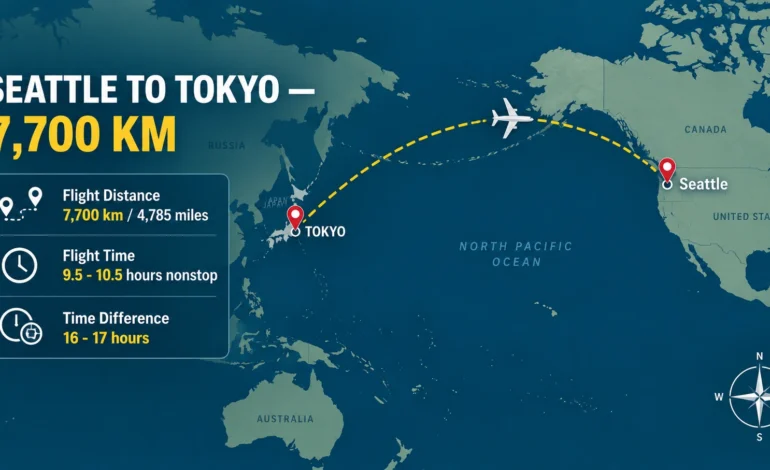
The Seattle to Tokyo distance km comes out to roughly 7,690 to 7,720 km (about 4,780 to 4,800 miles) as a straight-line flight distance. This Seattle to Tokyo distance km is unlike a lot of long-haul international routes, since it’s actually served by regular nonstop flights, which makes it one of the more convenient far-flung destinations to reach from the Pacific Northwest.
| Measurement | Value |
|---|---|
| Straight-line distance | 7,690–7,720 km (4,780–4,800 miles) |
| Nonstop flight time | 9.5–10.5 hours |
| Actual flown distance (accounting for flight paths) | ~3% longer than straight-line, roughly 7,900–7,910 km |
| Time difference | Tokyo is 16–17 hours ahead of Seattle |
| Direction from Seattle | West-northwest, arcing north over the Pacific |
Yes, Direct Flights Exist on This Route
This is worth flagging up front, since it’s genuinely different from a lot of other long-haul routes out of Seattle. Direct, nonstop flights between Seattle and Tokyo run regularly, primarily to Narita (NRT) and Haneda (HND) airports, operated by carriers including Delta, ANA, and Japan Airlines. This puts the Seattle to Tokyo distance km squarely within reach of a single flight, without the layover-driven time inflation you’d see on routes to destinations further from a major Pacific gateway.
| Airline | Typical Destination Airport | Notes |
|---|---|---|
| Delta | Narita (NRT) or Haneda (HND) | Frequent daily service, Seattle is a Delta hub for Asia routes |
| ANA (All Nippon Airways) | Narita (NRT) or Haneda (HND) | Japanese carrier, strong onward domestic Japan connections |
| Japan Airlines | Haneda (HND) | Haneda offers closer access to central Tokyo than Narita |
| United | Narita (NRT), via connections | More commonly routes through a West Coast or Asian hub |
Why the Distance Figure Varies Slightly
Different sources land on numbers ranging from about 7,690 km to 7,720 km for the Seattle to Tokyo distance km, and a couple of factors explain the spread. Some calculations use city-center coordinates, while others measure specific airport pairs, such as Seattle-Tacoma International (SEA) to Narita (NRT) versus SEA to Haneda (HND), which sit at slightly different points around the greater Tokyo area. On top of that, actual flown routes run roughly 3% longer than the theoretical straight-line distance, since real flights follow established air corridors and adjust for wind patterns and airspace restrictions rather than cutting a perfectly direct path.
The Route Curves North, and That’s Not a Typo
If you’ve ever glanced at a flight tracker mid-journey and wondered why a Seattle-to-Tokyo flight appears to be flying up toward Alaska instead of straight across the Pacific, there’s a good reason. Because the Earth is a sphere, the shortest path between two distant points curves toward the pole rather than running along a flat east-west line on a standard map projection. This means the great-circle route between Seattle and Tokyo arcs up over the Gulf of Alaska and the Aleutian Islands before curving back down toward Japan, and this genuinely is the shortest real-world path, even though it looks like a detour on a flat map.
Making Sense of the Time Difference
Tokyo sits 16 to 17 hours ahead of Seattle, depending on the time of year and how daylight saving adjustments line up between the two regions. Because the gap is so large, it’s often easier to think of it as Tokyo being roughly a day ahead rather than doing hour-by-hour math, and this matters practically: a flight departing Seattle in the evening typically lands in Tokyo two calendar days later, purely because of how the International Date Line and the time difference interact with a 10-hour flight.
| Departure Time (Seattle) | Approximate Arrival Time (Tokyo, local) |
|---|---|
| Morning departure | Late afternoon/evening, next day |
| Evening departure | Afternoon, two days later |
What the Trip Actually Costs the Planet
One detail that doesn’t come up often enough: a direct flight covering the Seattle to Tokyo distance km produces roughly 554 kilograms of CO2 per passenger on average. This figure is worth knowing if you’re weighing travel choices with environmental impact in mind, or simply curious about the footprint of a trip this long, since it puts a concrete number on what “long-haul” actually means in practical terms.
Comparing This Route to Other Pacific Crossings
| Route | Approximate Distance |
|---|---|
| Seattle to Tokyo | ~7,700 km |
| Seattle to Beijing | ~9,500 km |
| Seattle to Seoul | ~8,300 km |
| Los Angeles to Tokyo | ~8,800 km |
Seattle’s position as the northernmost major West Coast hub actually works in its favor here, since it sits noticeably closer to Tokyo than either Los Angeles or San Francisco, largely because of that great-circle route curving north rather than running in a flat line.
Quick Unit Conversion Reference for the Seattle to Tokyo Distance Km
Since this route gets searched in both kilometers and miles depending on where you’re from, here’s a quick reference for converting the Seattle to Tokyo distance km figure to miles.
| Kilometers | Miles |
|---|---|
| 7,690 km | 4,780 miles |
| 7,700 km | 4,785 miles |
| 7,710 km | 4,791 miles |
| 7,720 km | 4,797 miles |
What’s Actually Available at Each Airport Along the Seattle to Tokyo Distance Km
Since a flight this long often means real time spent in a terminal before boarding, it helps to know what each airport actually offers.
Seattle-Tacoma International Airport (SEA)
| Amenity | Details |
|---|---|
| Restrooms | Distributed across all concourses, with an all-gender restroom on Concourse D |
| Charging Stations | Power outlets built into seating at every gate |
| Lounges | 12 total, including Alaska Lounge, Delta Sky Club, and Centurion Lounge |
| Water Refill Stations | Available throughout the secure side of the airport |
| Nearby Hotels | Multiple airport-adjacent hotels along International Boulevard |
Narita International Airport (NRT)
| Amenity | Details |
|---|---|
| Restrooms | Located throughout all terminals, including accessible facilities |
| Charging Stations | Available at most gate areas and in lounge spaces |
| Lounges | Multiple lounges across Terminals 1 and 2, including airline-specific and pay-per-use options |
| Showers | Available in several paid lounges for long-haul arrivals |
| Nearby Hotels | Narita View Hotel, Hilton Narita, and several capsule hotel options within the terminal complex |
Haneda Airport (HND)
| Amenity | Details |
|---|---|
| Restrooms | Modern facilities throughout, considered among the cleanest of any major airport |
| Charging Stations | Widely available, including dedicated charging lounges |
| Lounges | Numerous lounges, including a large observation deck area |
| Proximity to City | Roughly 30 minutes to central Tokyo by train, closer than Narita |
| Nearby Hotels | Haneda Excel Hotel Tokyu, located directly inside the terminal |
Fighting Jet Lag on the Seattle to Tokyo Distance Km Route
A 16 to 17 hour time difference is one of the more extreme adjustments in international travel, and a few habits before departure make a real difference. Shifting your sleep schedule by an hour or two for two or three days before your flight gives your body a head start rather than forcing the entire adjustment during the flight itself. Staying hydrated and limiting alcohol during the flight helps more than most travelers expect, since dehydration tends to worsen jet lag symptoms on arrival. Once you land in Tokyo, getting outside into daylight as soon as possible, rather than heading straight to a hotel room to sleep, helps reset your internal clock faster than sleeping through the first afternoon.
How to Actually Book the Seattle to Tokyo Distance Km Route Well
Booking three to four months ahead generally secures better fares than waiting until the last month, particularly during Japan’s peak cherry blossom season in spring or the busy autumn foliage window in October and November. Comparing Delta, ANA, and Japan Airlines directly is worth the extra few minutes, since seat configurations and total travel time can vary meaningfully even among nonstop options. If your schedule allows flexibility, flying midweek rather than departing on a Friday or Sunday often results in a better fare for this route.
Things to Know Before Booking
Booking three to four months ahead generally secures better fares on this route than waiting until the last month, particularly for travel during Japan’s peak cherry blossom season in spring or the busy autumn foliage window. Haneda tends to be the more convenient arrival airport if your final destination is central Tokyo, since it sits considerably closer to the city than Narita, though Narita often has more flight frequency and occasionally lower fares. Given the significant time difference, an evening departure from Seattle, arriving in Tokyo in the afternoon two days later, tends to leave travelers less disoriented than a morning departure that lands in the middle of a Tokyo night.
Common Questions About This Route
Most sources place the straight-line distance between 7,690 and 7,720 km, with the actual flown distance running about 3% longer due to real-world flight paths.
Yes, and this is one of the better-served long-haul routes out of the Pacific Northwest, with regular nonstop service from Delta, ANA, and Japan Airlines to both Narita and Haneda.
A nonstop flight typically takes 9.5 to 10.5 hours, depending on winds and the specific routing used that day.
Tokyo runs 16 to 17 hours ahead of Seattle, which effectively means it’s easier to think of Tokyo as being about a day ahead rather than calculating the exact hourly gap.
Haneda is closer to central Tokyo and generally more convenient if that’s your final destination, while Narita sometimes offers more flight options or slightly lower fares depending on the season.