Seattle to Buenos Aires Distance (km): Flight Time, Layovers, and What to Expect

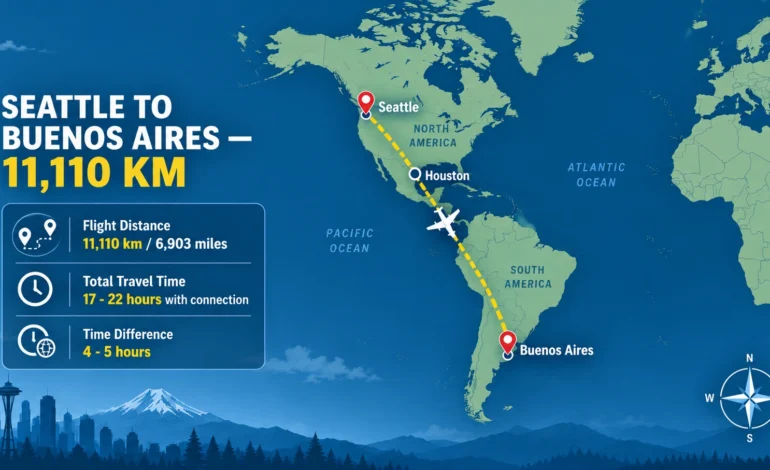
The Seattle to Buenos Aires distance km comes out to roughly 11,100 to 11,134 km (about 6,901 to 6,918 miles) as a straight-line flight distance. Unlike some long-haul routes out of Seattle, this one has no regular nonstop service, so nearly every itinerary involves at least one connection along the way.
| Measurement | Value |
|---|---|
| Straight-line distance | 11,100–11,134 km (6,901–6,918 miles) |
| Theoretical nonstop flight time | 13.5–14.3 hours |
| Realistic total travel time (with connection) | 17–22 hours, depending on layover |
| Time difference | Buenos Aires is 4–5 hours ahead of Seattle |
| Direction from Seattle | Southeast |
Why the Seattle to Buenos Aires Distance Km Figure Varies
Different calculators land on numbers between roughly 11,100 km and 11,134 km, and the spread comes down to a few technical factors rather than any real disagreement. Some tools use city-center coordinates for both Seattle and Buenos Aires, while others measure specific airport pairs, such as Seattle-Tacoma International (SEA) or Boeing Field (BFI) to Buenos Aires’s Ministro Pistarini International Airport (EZE). The calculation method matters too: Vincenty’s formula accounts for the Earth’s slight flattening at the poles, while the simpler haversine formula treats the planet as a perfect sphere, producing very slightly different results for a distance this long.
Why There’s No Direct Flight
This is the single most important thing to know before booking. No airline currently operates a regular nonstop flight between Seattle and Buenos Aires, which means every commercial itinerary involves at least one layover. The route length, combined with limited direct demand between these two specific cities, makes a nonstop service commercially difficult to sustain compared to routes connecting larger population centers.
| Common Connection Point | Operating Airline | Typical Total Travel Time |
|---|---|---|
| Houston (IAH) | United | ~17–19 hours |
| Atlanta (ATL) | Delta | ~18–20 hours |
| Miami (MIA) | American Airlines | ~18–21 hours |
| Panama City (PTY) | Copa Airlines | ~19–22 hours |
Houston tends to be one of the more efficient connection points for this specific route, given United’s strong Latin America network through that hub, though the fastest option on any given day depends heavily on flight schedules and layover length.
Making Sense of the Time Difference
Buenos Aires sits 4 to 5 hours ahead of Seattle, with the exact gap shifting depending on daylight saving transitions in the United States, since Argentina does not observe daylight saving time itself. This is a far smaller adjustment than routes to Asia or parts of Europe, which makes jet lag noticeably milder on this trip compared to a flight to somewhere like Tokyo or Rome.
| Season | Time Difference |
|---|---|
| U.S. Daylight Saving Time (spring–fall) | 4 hours ahead |
| U.S. Standard Time (fall–winter) | 5 hours ahead |
What the Trip Actually Costs the Planet
A flight covering the Seattle to Buenos Aires distance km produces roughly 841 kilograms of CO2 per passenger on average for a one-way trip. This figure is worth knowing if you’re factoring environmental impact into your travel decisions, or simply curious what a long-haul trip like this actually adds up to in concrete terms.
Quick Unit Conversion Reference for the Seattle to Buenos Aires Distance Km
Since this route gets searched in both kilometers and miles depending on where you’re from, here’s a quick reference for converting between the two.
| Kilometers | Miles |
|---|---|
| 11,100 km | 6,896 miles |
| 11,109 km | 6,903 miles |
| 11,120 km | 6,910 miles |
| 11,134 km | 6,918 miles |
What’s Actually Available at Each Airport Along the Seattle to Buenos Aires Distance Km
Given that this trip almost always involves a layover, it’s worth knowing what facilities are available at the departure, connection, and arrival points.
Seattle-Tacoma International Airport (SEA)
| Amenity | Details |
|---|---|
| Restrooms | Distributed across all concourses, including an all-gender restroom on Concourse D |
| Charging Stations | Power outlets built into seating at every gate |
| Lounges | 12 total, including Alaska Lounge, Delta Sky Club, and Centurion Lounge |
| Nearby Hotels | Multiple airport-adjacent hotels along International Boulevard |
Ministro Pistarini International Airport (EZE), Buenos Aires
| Amenity | Details |
|---|---|
| Restrooms | Available throughout both terminals |
| Charging Stations | Present in gate areas and lounge spaces |
| Lounges | Multiple lounges, including options from Star Alliance and SkyTeam partner airlines |
| Distance to City Center | Approximately 22 miles (35 km), roughly 40–50 minutes by car |
| Currency Exchange | Available in the arrivals area, though rates at the airport are often less favorable than in the city |
The Route Curves Toward the Equator, Not a Straight Diagonal
If you glance at a flight tracker during this journey, the path won’t look like a perfectly straight diagonal line across a flat map, and there’s a real reason for that. Because the Earth is a sphere, the shortest path between two distant points, known as the great-circle route, curves slightly compared to a straight line drawn on a standard map projection. For a north-south-leaning route like Seattle to Buenos Aires, this effect is less dramatic than on an east-west transpacific or transatlantic route, but flight paths still adjust for wind patterns, established air corridors, and airspace restrictions, which is part of why the actual flown distance typically runs a bit longer than the theoretical straight-line figure.
Best Time of Year to Cover the Seattle to Buenos Aires Distance Km
Argentina’s seasons run opposite to the Northern Hemisphere, which matters a lot when planning around the Seattle to Buenos Aires distance km. Summer in Buenos Aires runs from December through February, corresponding to winter back in Seattle, and this period draws the heaviest travel demand thanks to warm weather and access to Patagonia’s peak hiking season further south. Buenos Aires’s own winter, June through August, brings cooler, quieter conditions and often better airfares, since demand drops outside the peak summer travel window.
| Season in Buenos Aires | Corresponding Months | Travel Demand |
|---|---|---|
| Summer | December–February | Highest, warmest weather |
| Autumn | March–May | Moderate, pleasant temperatures |
| Winter | June–August | Lowest demand, cooler weather |
| Spring | September–November | Moderate, rising toward summer |
Passport and Entry Requirements Worth Checking Early
Beyond the flight itself, it’s worth confirming entry requirements well before booking, since these can change and vary by nationality. Most travelers from the United States do not currently need a visa for short tourist stays in Argentina, though passport validity requirements and any reciprocity fees should always be confirmed against the most current government guidance rather than assumed from an older trip. If your connection routes through a country with its own transit visa rules, such as certain Central American hubs, it’s worth checking those requirements separately from Argentina’s own entry rules.
Fighting Fatigue on a Long Connecting Itinerary
Since this route almost always involves 17 or more hours of total travel time, managing fatigue matters even though the time difference itself is relatively mild. Staying hydrated throughout both flight segments helps more than most travelers expect, since dry cabin air combined with a long layover compounds general travel exhaustion. Choosing a connection point with a reasonable layover window, ideally 90 minutes to two hours, avoids both the stress of a tight connection and the wasted time of an overly long one. If your layover runs several hours, many connecting airports, including Houston and Atlanta, offer day-use hotel rooms or quiet lounge areas worth booking in advance for a longer break.
How to Actually Book the Seattle to Buenos Aires Distance Km Route Well
Booking two to four months ahead generally secures better fares on this route than waiting until the last month, particularly around Argentina’s summer season from December through February, which draws heavier demand due to favorable weather for visiting Buenos Aires and Patagonia. Comparing itineraries through Houston, Atlanta, Miami, and Panama City specifically is worth the extra research time, since total travel time and layover length can vary by several hours between otherwise similarly priced options. Checking whether your connecting airline requires a visa transit through the layover country is also worth confirming ahead of time, since this varies by passport and connection point.
Comparing This Route to Other Long South America Flights
| Route | Approximate Distance |
|---|---|
| Seattle to Buenos Aires | ~11,110 km |
| New York to Buenos Aires | ~8,500 km |
| Los Angeles to Buenos Aires | ~9,700 km |
| Seattle to Santiago, Chile | ~9,800 km |
Seattle’s distance from South America is genuinely one of the longer domestic-to-South-America routes in the United States, since the Pacific Northwest sits further from the equator and further west than most major connecting hubs serving Latin America.
Frequently Asked Questions
Most sources place the straight-line distance between 11,100 and 11,134 km, depending on whether the measurement uses city centers or specific airport coordinates.
No. There is currently no regular nonstop service between these two cities, so every commercial itinerary requires at least one connection, commonly through Houston, Atlanta, Miami, or Panama City.
Realistically, expect 17 to 22 hours of total travel time including a layover, compared to the theoretical 13.5 to 14.3 hour nonstop flight time the straight-line distance alone would suggest.
Buenos Aires runs 4 to 5 hours ahead of Seattle, with the smaller gap during U.S. daylight saving time, since Argentina does not observe its own daylight saving schedule.
Houston via United tends to offer some of the more efficient connections given its strong Latin America network, though the best option on any given day depends on specific flight schedules and layover length.