Naches Peak Loop: The Easiest Big-Payoff Hike Near Mount Rainier

If you’re looking for a hike that hands you alpine lakes, wildflower meadows, and postcard views of Mount Rainier without demanding a full day or serious fitness, Naches Peak Loop is about as close to a sure thing as Washington hiking gets. I’ve brought first-time hikers, tired kids, and out-of-town visitors on this loop more times than I can count, and it delivers every single time.
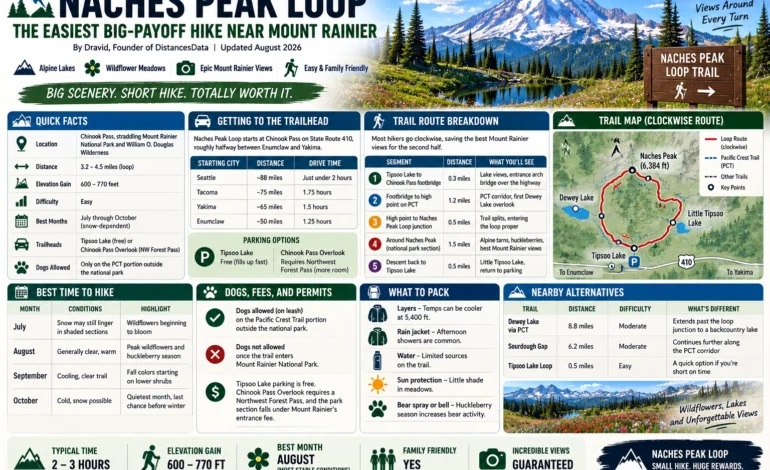
| Detail | Info |
|---|---|
| Location | Chinook Pass, straddling Mount Rainier National Park and William O. Douglas Wilderness |
| Distance | 3.2–4.5 miles, loop (varies by trailhead used) |
| Elevation Gain | 600–770 feet |
| Difficulty | Easy |
| Best Months | July through October, snow-dependent |
| Trailheads | Tipsoo Lake (free) or Chinook Pass Overlook (Northwest Forest Pass required) |
| Dogs Allowed | Only on the Pacific Crest Trail portion outside the national park boundary |
Why This Loop Punches Above Its Weight
Naches Peak Loop manages something a lot of harder hikes never quite pull off: it delivers two alpine lakes, sweeping wildflower meadows, and one of the best close-up views of Mount Rainier anywhere in the region, all within a distance most people can finish in two to three hours. The trail circles Naches Peak itself, crossing briefly into Mount Rainier National Park before returning to the Pacific Crest Trail corridor, so you actually get a taste of both the park and the surrounding wilderness in a single short outing.
Getting to the Trailhead
Naches Peak Loop starts at Chinook Pass on State Route 410, roughly halfway between Enumclaw and Yakima.
| Starting City | Distance | Drive Time |
|---|---|---|
| Seattle | ~88 miles | Just under 2 hours |
| Tacoma | ~75 miles | 1.75 hours |
| Yakima | ~65 miles | 1.5 hours |
| Enumclaw | ~50 miles | 1.25 hours |
Two main parking options exist for Naches Peak Loop: the free Tipsoo Lake picnic area, which fills up fast on summer weekends, and the Chinook Pass Overlook lot just east of the pass, which requires a Northwest Forest Pass but tends to have a bit more room.
Route Breakdown
Most hikers do Naches Peak Loop clockwise, starting from Tipsoo Lake, crossing a wooden footbridge over Highway 410, and picking up the Pacific Crest Trail before circling back through the national park section.
| Segment | Approximate Distance | What You’ll See |
|---|---|---|
| Tipsoo Lake to Chinook Pass footbridge | 0.3 miles | Lake views, entrance arch bridge over the highway |
| Footbridge to high point on PCT | 1.2 miles | Pacific Crest Trail corridor, first Dewey Lake overlook |
| High point to Naches Peak Loop junction | 0.5 miles | Trail splits from the PCT, entering the loop proper |
| Around Naches Peak (national park section) | 1.5 miles | Alpine tarns, huckleberries, best Mount Rainier views |
| Descent back to Tipsoo Lake | 0.5 miles | Little Tipsoo Lake, return to parking |
Hiking clockwise saves the best Mount Rainier views for the second half of Naches Peak Loop, which is exactly why most experienced hikers recommend this direction over going counterclockwise.
Best Time to Hike
Naches Peak Loop is typically accessible from July through October, though exact timing shifts year to year based on how much snow lingers at this elevation.
| Month | Conditions | Highlight |
|---|---|---|
| July | Snow may still linger in shaded sections | Wildflowers beginning to bloom |
| August | Generally clear, warm | Peak wildflowers and huckleberry season |
| September | Cooling, clear trail | Fall colors starting on lower shrubs |
| October | Cold, snow possible | Quietest month, last chance before winter |
August is genuinely the sweet spot for most visitors doing Naches Peak Loop, combining reliably clear trail conditions with the fullest wildflower displays of the entire season.
Dogs, Fees, and Permits
This is one of the more confusing logistics points for first-time visitors, so it’s worth spelling out clearly. Naches Peak Loop crosses back and forth between Mount Rainier National Park and the surrounding William O. Douglas Wilderness, and the rules differ depending on which section you’re in. Dogs on leash are permitted on the Pacific Crest Trail portion outside the park boundary, but not allowed once the trail enters Mount Rainier National Park itself. If you’re parking at Tipsoo Lake, no fee applies, but the Chinook Pass Overlook lot requires a Northwest Forest Pass, and entering the national park section of the loop technically falls under Mount Rainier’s standard entrance fee structure.
What to Pack
Even at a relatively low elevation gain, weather at Chinook Pass can shift quickly given its exposure.
| Item | Why It Matters |
|---|---|
| Layers | Temperatures at 5,400 feet run cooler than nearby lowland trails |
| Rain jacket | Afternoon showers are common in this part of the Cascades |
| Water | Limited reliable sources directly on the trail |
| Sun protection | Meadow sections offer little shade |
| Bear spray or bell | Huckleberry season increases black bear activity nearby |
Nearby Alternatives If You Want More
If you’ve already done this hike or want to pair it with something else during your visit, a few nearby trails offer a similar flavor with more distance or elevation.
| Trail | Distance | Difficulty | What’s Different |
|---|---|---|---|
| Dewey Lake via PCT | 8.8 miles | Moderate | Extends past the loop junction to a proper backcountry lake |
| Sourdough Gap | 6.2 miles | Moderate | Continues further along the Pacific Crest Trail corridor |
| Tipsoo Lake Loop | 0.5 miles | Easy | A quick standalone option if you’re short on time |
Frequently Asked Questions
Most hikers finish in two to three hours, making it an easy half-day outing rather than a full-day commitment.
Yes, it’s widely considered one of the better family-friendly options near Mount Rainier, thanks to its short distance, modest elevation gain, and consistently rewarding scenery throughout.
Parking at Tipsoo Lake is free, though it fills quickly. Parking at Chinook Pass Overlook requires a Northwest Forest Pass, and the section of the loop inside Mount Rainier National Park technically falls under the park’s entrance fee.
Only on the portion outside Mount Rainier National Park, along the Pacific Crest Trail corridor. Dogs are not permitted once the trail crosses into the national park section of the loop.