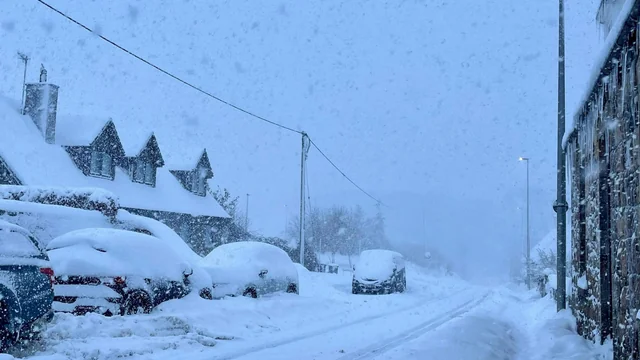

The road outside the house looks fine. The car starts. The forecast says “snow later,” which is comfortably vague. So the trip should be all right… should it not?
That is how many difficult winter journeys begin: with conditions judged from one window. Snow may be light at home and heavy on higher ground. A wet road at noon can become ice after dark. A train can leave on time and still terminate early because points freeze farther along the route.
Useful snow travel tips UK travellers can act on should answer one question first: does this journey need to happen now? Everything else—blankets, de-icer, a charged phone—comes after that.
Five Checks Before the Coat Goes On
Look at the full route and the return time, not only the first ten miles. Conditions can be very different across a hill, a county boundary or a rural final stretch.
Use official, live information. A social post from an hour ago may describe a road that has since closed.
| Check | What it tells you |
|---|---|
| Met Office warning | Expected weather, area and likely impact |
| National Highways or local roads | Incidents, closures and treatment information |
| Train operator | Cancellations, delays and ticket changes |
| Vehicle check | Whether tyres, lights and fluids are ready |
| Return forecast | Whether wet snow may freeze after sunset |
Read the text attached to a warning. The colour matters, but so do timing and impact. A yellow warning may be manageable for one main-road commute and a poor choice for a steep, untreated lane.
Then ask the uncomfortable question: if the car stops for two hours, or the last train is cancelled, what happens next? If the answer is “I have no idea,” the travel plan is not finished.
Go, Delay or Change the Plan?
There is no table that can decide every journey. A hospital shift, a grocery run and a weekend lunch do not carry the same need.
Still, these examples help turn a weather warning into a decision instead of a shrug.
| Situation | A sensible response |
|---|---|
| Light snow, treated main roads and good visibility | Allow more time and keep checking |
| Yellow warning plus untreated rural roads | Use a main-road route or delay |
| Amber warning affecting most of the route | Skip trips that can wait |
| Daytime thaw followed by a freezing evening | Reconsider the return journey |
| Reduced rail service | Travel only with a backup and flexible timing |
| Care or medical trip that cannot wait | Contact the service and ask about the safest option |
Cancelling an optional trip is not overreacting. It is one less vehicle that emergency services or gritters need to work around.
If the trip cannot wait, tell someone the route and likely arrival time. Share changes. A silent delay becomes much more worrying once phone reception disappears.
Prepare the Car Before Snow Is Falling Sideways
Clear every window, mirror, light and the roof. A small letter-box view through the windscreen is not enough. Snow left on the roof can slide forward under braking or blow onto another vehicle.
Check tyre pressure and tread, screenwash suitable for winter temperatures, fuel or charge, lights and wipers. A half-empty tank feels much emptier during a long diversion with the heater running.
| Put in the car | Why it helps | Where to keep it |
|---|---|---|
| Warm coat, gloves and blanket | Protects you if the heater stops | Cabin, not under other luggage |
| Water and a snack | Makes a long wait easier | Easy-to-reach bag |
| Ice scraper and de-icer | Clears glass without boiling water | Door pocket or boot edge |
| Phone cable and charged power bank | Keeps calls and updates available | Cabin |
| Torch and bright outer layer | Helps you see and be seen | Glove box or side pocket |
| Small shovel in heavy-snow areas | Helps with loose snow around tyres | Boot |
| Medicine you must take | A delay may last for hours | Cabin, in labelled packaging |
This is not expedition equipment. It is a way to make an ordinary breakdown less unpleasant while help arrives.
Do not pour boiling water onto a frozen windscreen; sudden temperature change can damage glass. Use an appropriate scraper, de-icer and the vehicle’s demisting system.

Drive as Though Every Input Has a Delay
Snow and ice reduce grip. Steering, braking and acceleration should all become gentle. Move off slowly, use a higher gear where the vehicle handbook recommends it, and leave a much larger gap.
Avoid sudden braking into a bend. Reduce speed before the turn, steer smoothly and accelerate only when the wheels are straighter. If the car begins to lose grip, look where you want to go and avoid panicked, sharp inputs.
Use dipped headlights when visibility is poor. Daytime running lights may not illuminate the rear of every vehicle. Clear snow from lamps whenever you stop safely.
Cruise control is a poor choice on slippery roads because the driver needs direct, careful control. Also, four-wheel drive may help a vehicle move; it does not give magical stopping power.
Stopping Distance Becomes the Big Number
Highway Code stopping distances are already longer than many drivers imagine. In snow or ice, the total distance can be up to ten times the dry-road figure.
These are broad safety illustrations, not targets. Grip can be worse on compacted snow, black ice, a downhill road or worn tyres.
| Speed | Typical dry-road stopping distance | Up to roughly 10× in snow or ice |
|---|---|---|
| 30 mph | 23 m / 75 ft | 230 m / 755 ft |
| 40 mph | 36 m / 118 ft | 360 m / 1,181 ft |
| 50 mph | 53 m / 175 ft | 530 m / 1,739 ft |
| 60 mph | 73 m / 240 ft | 730 m / 2,395 ft |
| 70 mph | 96 m / 315 ft | 960 m / 3,150 ft |
At 30 mph, 230 metres is more than two football pitches. That is why “I was under the speed limit” is not a complete winter-driving defence. The safe speed may be far lower.
If the car behind is too close, do not brake to teach a lesson. Increase the gap ahead so there is more space to slow gently.
Main Roads Are Usually the Better Bet
Navigation apps often chase the shortest arrival time. In snow, that may lead to an untreated lane, a steep shortcut or a road that looks normal on the map and miserable in real life.
Prefer major roads that are more likely to be treated and patrolled. A longer route can be the quicker one once a car is stuck behind a blocked hill.
Give gritters room. Do not overtake unless it is clearly safe and legal. The road ahead of the gritter may be worse than the surface behind it—that is rather the point of the vehicle being there.
Rural bridges, shaded bends and high ground can freeze first. Slow down before the surface changes, not once the car begins to slide.
Black Ice Is the Quiet Problem
Fresh snow is visible. Black ice can look like a wet patch or nothing at all. It is common where water refreezes, especially on bridges, exposed roads and shaded stretches.
The dangerous window may arrive after the snowfall ends. Daytime sun melts slush; evening temperature drops; the same route home is suddenly harder than the outward journey.
Watch the temperature and return forecast. If conditions are worsening, leave earlier, stay overnight or cancel. “But the journey here was fine” does not describe the road now.
Rail Travel Needs a Backup Too
Snow affects points, power systems, trains and staff travel. Services may run less often, start late or finish early. Check the operator before leaving home and again before returning.
Use a route with fewer changes when possible. A ten-minute connection that looks efficient on paper can become a missed last train after one delay.
Carry a charged phone, water, medication and a warm layer even for a short rail journey. Know whether the ticket can be used on another service or route during disruption. Do not assume an app will remain updated when mobile coverage is weak.
If stranded, speak to staff rather than improvising a walk along an unsafe road or trackside area.
If the Vehicle Breaks Down
Move to a safer position only if that can be done without creating more danger. Use hazard lights and follow the road operator’s instructions for the type of road you are on.
On a motorway, the safest place is not automatically inside the car. Advice differs depending on whether the vehicle reaches a refuge or hard shoulder and whether passengers can leave safely. Follow current official breakdown guidance and emergency instructions.
Tell the breakdown provider the road, direction, nearest marker and number of passengers. Conserve phone power. Put warm layers on before the cabin cools.
Never stand where another sliding vehicle could reach you. And do not attempt a long walk in poor visibility simply because the destination “is only a mile away.”
A Better Return-Journey Plan
Before leaving the destination, repeat the five checks. Not one of them. All five. Roads close, warnings change and trains are withdrawn.
Set a decision time: “If the warning reaches our route by 4 p.m., we stay.” This is easier than debating the same question in a car park after dark.
Keep alternative accommodation, a later rail route or a safe person to call in mind. A backup does not make disruption more likely; it makes a disruption easier to handle.
Frequently Asked Questions
Yellow does not automatically ban travel. Read the affected area, time and expected impact, then judge the actual route and whether the journey is necessary.
They are not generally a legal requirement, but suitable tyres in good condition matter. Check the rules for any country reached during an international drive.
Yes, but services may be reduced or cancelled. Check the operator and the last realistic journey home.
There is no single item. Warmth, communication, water, medication and a plan work together.
Before You Turn the Key
The most important snow travel tips UK passengers can remember are not about driving technique. They are about judgement. Check the whole route. Check the return. Be willing to wait.
The safest winter journey is sometimes the one moved to tomorrow. There is no shame in that—only a warmer cup of tea at home.