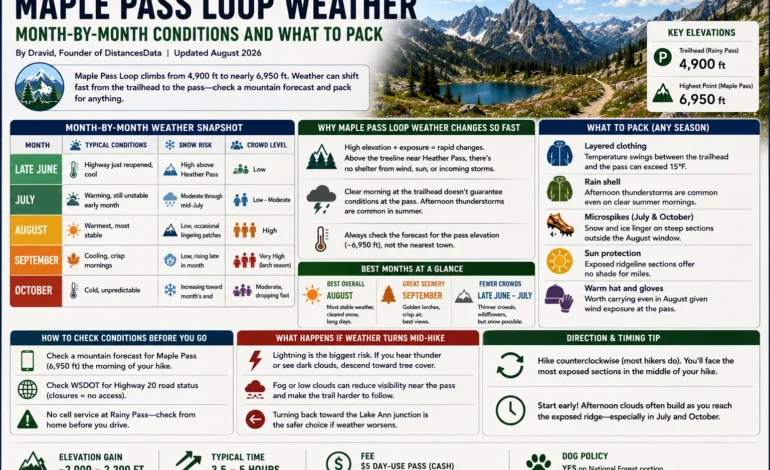
Maple Pass Loop Weather: Month-by-Month Conditions and What to Pack

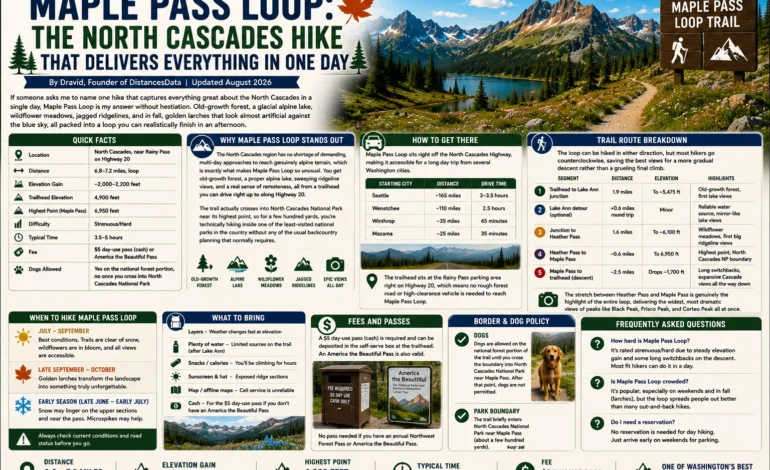
Checking Maple Pass Loop weather the night before your hike isn’t optional here, it’s essential. This trail climbs from 4,900 feet at the trailhead to nearly 6,950 feet at its highest point, and that elevation swing means conditions can shift from pleasant to genuinely dangerous faster than most hikers expect. After tracking Maple Pass Loop weather across three different seasons of hiking this trail myself, here’s the honest breakdown of what to actually expect month by month.
Quick Weather Snapshot
Maple Pass Loop weather follows the same broad pattern every year, tied directly to when Highway 20 opens and closes for the season.
| Month | Typical Conditions | Snow Risk | Crowd Level |
|---|---|---|---|
| Late June | Highway just reopened, cool | High above Heather Pass | Low |
| July | Warming, still unstable early month | Moderate through mid-July | Low-Moderate |
| August | Warmest, most stable | Low, occasional lingering patches | High |
| September | Cooling, crisp mornings | Low, rising late in month | Very High (larch season) |
| October | Cold, unpredictable | Increasing toward month’s end | Moderate, dropping fast |
Why Maple Pass Loop Weather Changes So Fast
The short answer is elevation combined with exposure. Once you climb past the treeline near Heather Pass, there’s essentially no shelter from wind, sun, or incoming storms for the rest of the loop until you begin the descent switchbacks. A clear morning at the trailhead offers no real guarantee about conditions at Maple Pass itself two hours later, since afternoon thunderstorms are common at this elevation throughout the summer months. This is exactly why checking Maple Pass Loop weather forecasts specifically for the pass elevation, not just the nearest town, matters more here than on most Washington trails.
July: Snow Still Lingers
Early July Maple Pass Loop weather often includes real snow above Heather Pass, even as the lower sections of the trail have cleared completely. Microspikes are genuinely worth carrying if you’re hiking before mid-July, since packed snow on the steeper switchback sections can be more treacherous than people expect from a summer hike. The upside to this window is thinner crowds and wildflowers just beginning their bloom, which makes early July appealing if you don’t mind some snow crossings.
August: The Reliable Window
If you want the most predictable Maple Pass Loop weather of the entire season, August is your best bet. Snow has generally cleared from all but the most persistent patches near the pass, wildflowers are at or near peak bloom, and days are long enough to start a bit later without racing the sunset. This stability comes at a cost, though: August also brings the heaviest general crowds outside of peak larch season, so an early start still matters for parking even when the weather itself isn’t a concern.
September and October: Cooler but Riskier
By mid-to-late September, Maple Pass Loop weather starts cooling noticeably, with crisp mornings that can dip close to freezing even while afternoons stay pleasant. This is also peak larch season, when the golden trees around Lake Ann and along the upper ridge draw the largest crowds of the year, so good weather and heavy trail traffic tend to arrive at the same time. By October, conditions become considerably less predictable. Snow can return with little warning, temperatures drop well below what a summer visit would suggest, and Highway 20 itself can close on short notice if an early winter storm rolls through the North Cascades.
What to Pack for Any Season
Given how quickly Maple Pass Loop weather can shift, packing for variability matters more than packing for whatever the forecast says the night before.
| Item | Why It Matters |
|---|---|
| Layered clothing | Temperature swings between the trailhead and the pass can exceed 15°F |
| Rain shell | Afternoon thunderstorms are common even on clear summer mornings |
| Microspikes (July and October) | Snow and ice linger on steep sections outside the August window |
| Sun protection | Exposed ridgeline sections offer no shade for miles |
| Warm hat and gloves | Worth carrying even in August given wind exposure at the pass |
How to Check Conditions Before You Go
Cell service at Rainy Pass is virtually nonexistent, so checking Maple Pass Loop weather the morning of your hike from home, rather than relying on updates once you’re on the road, is the smarter approach. A dedicated mountain weather forecast for the pass elevation gives a more accurate picture than a general forecast for the nearest town, since temperature and precipitation at 6,950 feet can look completely different from conditions at valley level. Checking the Washington State Department of Transportation’s website for Highway 20 status is also worth doing in early or late season, since road closures directly determine whether the trailhead is even reachable that day.
What Happens If Weather Turns Mid-Hike
Given how exposed the upper sections of this loop are, it’s worth having a plan for what to do if conditions deteriorate while you’re already past Heather Pass. Lightning is the most serious concern on the open ridge sections, and if you hear thunder or see building dark clouds, the safest move is descending toward tree cover rather than continuing toward the higher, more exposed Maple Pass itself. Fog and sudden low cloud cover can also reduce visibility dramatically near the pass, making the trail harder to follow even though it’s well marked in clear conditions. Turning back toward the Lake Ann junction, which sits at slightly lower elevation and closer to tree cover, is generally the better call than pushing forward if you’re uncertain about incoming weather.
How Weather Varies by Direction You Hike
Hiking counterclockwise, which most visitors choose, means you’ll face the more exposed sections in the middle of your hike rather than at the very start or end. This matters for weather planning specifically, since an early morning start in clear conditions can still put you on the most exposed part of the ridge right as afternoon clouds typically build. Starting earlier than you think necessary, particularly during the unpredictable shoulder seasons of July and October, gives you a buffer against this common pattern.
Frequently Asked Questions
August offers the most consistently stable conditions, with cleared snow, warm temperatures, and long daylight hours. September brings excellent weather too, but with the tradeoff of much heavier crowds during peak larch season.
It can, particularly in early July above Heather Pass. Snow at this elevation typically clears by mid-July in an average year, though timing shifts depending on the previous winter’s snowpack.
Temperatures at the pass run noticeably colder than the trailhead, often 10 to 15 degrees cooler, with wind exposure making it feel colder still. Even on a warm August day, a jacket at the summit is a smart addition to your pack.