Miami to Orlando Distance: Miles, Route and Travel Time

Whether you’re searching the distance from Miami to Orlando or the Miami to Orlando distance, the answer is the same: about 230 to 250 miles, with a drive time of roughly 3.5 to 4 hours. This is one of Florida’s busiest travel corridors, connecting the state’s biggest metro area to its top tourist destination, and there’s now a genuinely fast train option too. Here’s the full breakdown.
| Detail | Information |
|---|---|
| Road Distance | 230–250 miles |
| Straight-Line Distance | 200 miles (322 km) |
| Driving Time | 3 hr 30 min to 4 hr |
| Brightline Train Time | 2 hr 59 min (nonstop) to 3 hr 30 min |
| Flight Time | About 1 hour |
| Main Route | Florida’s Turnpike or I-95 |
The Drive: Turnpike vs I-95
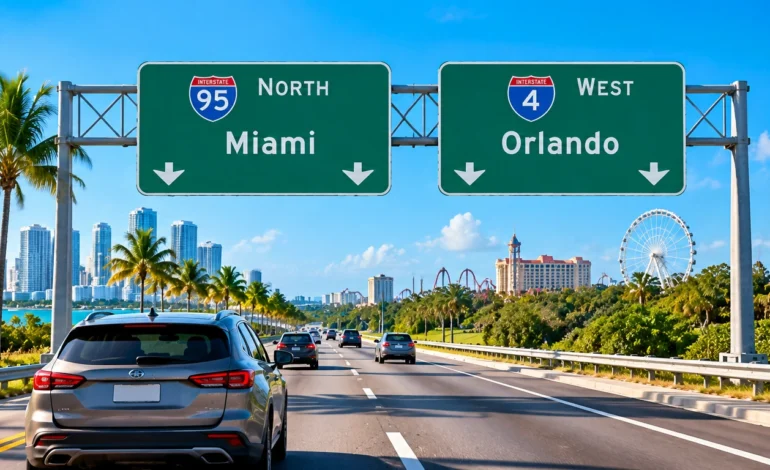
Florida’s Turnpike is the most common route covering the Miami to Orlando distance, running fairly direct through central Florida with a toll attached. I-95 North to I-4 West is the alternative, hugging closer to the coast before cutting inland near Daytona. Both routes land in the 230 to 250 mile range and take about 3.5 to 4 hours under normal traffic, though the Turnpike tends to be the smoother, more predictable option since it sees less stop-and-go congestion than I-95’s urban stretches.
Brightline: The Fast Train Option
This is what makes the Miami to Orlando distance different from most Florida routes — a genuinely competitive high-speed rail option. Brightline’s nonstop trains cover Miami to Orlando in 2 hours 59 minutes, while regular service with stops at Aventura, Fort Lauderdale, Boca Raton, and West Palm Beach takes about 3 hours 30 minutes. As of late 2025, Brightline runs 20 daily departures between the two cities. One-way SMART fares start around $54, with PREMIUM service starting near $109. For many travelers, especially those not needing a car once they arrive, this beats driving on both time and stress.
Flying: Fastest, But Airport Time Adds Up
A direct flight between Miami International (MIA) and Orlando International (MCO) takes about an hour in the air. Multiple airlines run frequent daily flights on this route. Once you add security, boarding, and getting to and from each airport, though, total door-to-door time often ends up close to what Brightline offers, minus the flexibility of a train that drops you closer to the action.
Cost Comparison
Driving remains the cheapest option if you’re splitting gas with passengers, but Brightline has genuinely changed the math for solo travelers who don’t need a car at their destination.
| Option | Typical Cost (one way) | Time | Best For |
|---|---|---|---|
| Driving | Gas + toll, roughly $30–$45 | 3.5–4 hours | Flexibility, no car needed at either end otherwise |
| Brightline Train | $54–$109+ | 3–3.5 hours | No driving, no traffic stress |
| Flying | $60–$200+ | ~1 hr in air | Tight schedules |
Best Time to Travel
| Season | Traffic/Demand | Notes |
|---|---|---|
| Winter (Dec–Feb) | Heavy | Peak tourist season, book trains early |
| Spring (Mar–Apr) | Heavy | Spring break traffic on I-4 and Turnpike |
| Summer (Jun–Aug) | Moderate–Heavy | Family travel season |
| Fall (Sep–Nov) | Lighter | Best value and traffic conditions |
Why This Route Gets So Much Traffic
Tourism drives a huge share of it, with millions of visitors flying into Miami and continuing on to Orlando’s theme parks, or vice versa when returning home through Miami’s larger international flight network. Business travel between Florida’s two biggest economic hubs adds a steady stream too. Since Brightline launched full Orlando service, a noticeable share of that traffic has shifted from cars and planes onto the train, especially among travelers who find airport security more hassle than it’s worth for a route this length.
Nearby Stops and Things to See Along the Way
If you’re driving instead of taking the train, a few stops break up the trip nicely. Yeehaw Junction sits roughly at the midpoint of the Turnpike route, offering a basic but reliable fuel stop. Kissimmee, closer to the Orlando side, makes a good final stretch stop before reaching the theme park corridor, with plenty of chain restaurants and gas stations right off the highway. If you’re taking I-95 instead, Melbourne and Cocoa both offer reasonable break points with easy highway access.
Where to Stay at Each End
If you’re taking Brightline in either direction, staying near the Miami Central or Orlando MCO stations cuts down significantly on the extra transfer time before and after your train ride, which is worth factoring in when comparing total trip time against driving.
| City | Area | What’s There |
|---|---|---|
| Miami | Downtown / Brickell | Business hotels, walkable to Brightline station |
| Miami | South Beach | Beach access, nightlife, higher prices |
| Orlando | International Drive | Close to theme parks, wide hotel range |
| Orlando | Downtown | Business travel, closer to Brightline station |
What to Pack for the Drive
Regardless of which route you take to cover the Miami to Orlando distance, sun protection and water are worth having on hand, since central Florida heat is intense for much of the year. If you’re driving through the summer months, plan for afternoon thunderstorms that can reduce visibility quickly, especially in the stretch through Osceola and Orange counties. Cell coverage stays reliable along both the Turnpike and I-95 for the entire route, so navigation apps should work without issue the whole way.
Quick Answers
About 230 to 250 miles by road, depending on the route.
Roughly 3 hours 30 minutes to 4 hours under normal traffic.
For many travelers, yes — nonstop service takes under 3 hours and skips both traffic and airport hassle.
Flying is fastest in the air at about an hour, but door-to-door time often rivals Brightline once airport time is factored in.
Florida’s Turnpike is generally smoother and more predictable, though it comes with tolls.
Before You Go
Book Brightline tickets in advance during peak winter and spring break season, since popular departure times sell out. If driving, keep a toll payment method like SunPass handy for the Turnpike. And whichever option you choose to cover the Miami to Orlando distance, build in extra buffer time during major holidays, when both the roads and the trains see their heaviest demand.
If you’re renting a car for the trip, book it early during peak seasons too, since demand in both cities spikes right alongside the traffic. Travelers covering the Miami to Orlando distance for a theme park vacation should also factor in that Orlando’s rental counters can have long lines during check-in and return, especially on weekends, so padding extra time before a flight is worth doing.