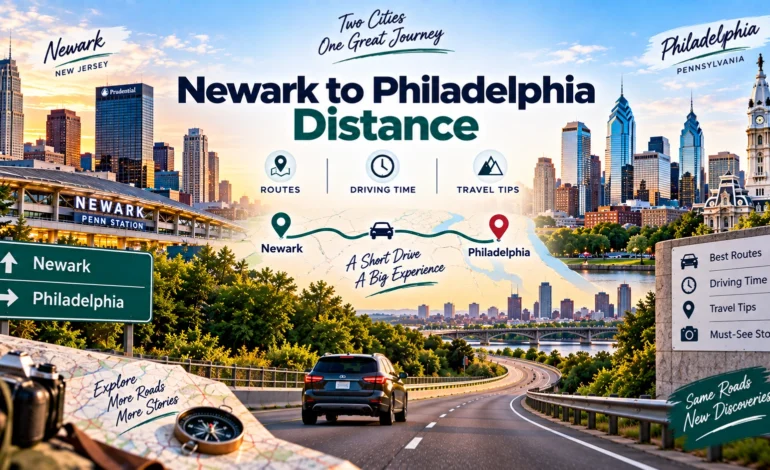
Newark to Philadelphia Distance: Miles, Route and Travel Time

Quick answer: the Newark to Philadelphia distance is about 80 to 85 miles by road, and you’ve got four real ways to cover it — driving, train, bus, or a quick flight. Unlike a lot of city pairs where one option obviously wins, this one’s genuinely a toss-up depending on what you care about. Let’s break it down.
| Detail | Information |
|---|---|
| Road Distance | 80–85 miles |
| Straight-Line Distance | 75 miles (121 km) |
| Driving Time | 1 hr 30 min to 1 hr 45 min |
| Train Time | 1 hr 15 min to 1 hr 30 min |
| Flight Time | About 1 hour (gate to gate) |
| Main Route | NJ Turnpike South to I-95 South |
| Airports | Newark Liberty (EWR), Philadelphia Intl (PHL) |
Every Way to Get There, Ranked
Train wins for pure convenience. Amtrak’s Northeast Regional and the pricier Acela both run from Newark Penn Station straight into Philadelphia’s 30th Street Station, no transfers, no traffic to worry about, and you’re there in about 75 to 90 minutes. If you just want to sit down and let someone else handle the driving, this is your answer.
Driving covers the Newark to Philadelphia distance in roughly 1 hour 30 minutes to 1 hour 45 minutes, and it’s the only option that gives you a car once you land in Philly. That flexibility matters if you’re not just sticking to downtown.
Flying is technically the fastest in the air, around an hour gate to gate, but let’s be honest — by the time you factor in getting to Newark Liberty, security, boarding, and then getting from Philadelphia International into the actual city, you’ve probably spent more total time than just driving would’ve taken. Book this one only if you’re connecting through anyway.
Bus is the budget pick. Greyhound and a couple of other carriers make the trip in about 1 hour 45 minutes to 2 hours, cheaper than the train but a little less comfortable and less frequent. Still, for covering the Newark to Philadelphia distance on a tight budget, it’s hard to beat.
The Drive Itself
If you’re going by car, the route is simple: NJ Turnpike South out of Newark, then merge onto I-95 South, which carries you the rest of the way into Philadelphia. It’s about as direct as New Jersey highways get, which honestly isn’t something you hear said very often.
The Newark to Philadelphia distance covers pretty smoothly outside of rush hour, usually right around that 90-minute mark. Toss in heavy traffic and you could be looking at closer to two hours, especially if you’re hitting the Turnpike during a weekday evening when everyone in North Jersey seems to have the same idea as you.
When the Roads Get Ugly
Rush hour is the obvious culprit — weekday mornings and especially late afternoons on the Turnpike can turn a 90-minute drive into something a lot longer. Construction pops up periodically too, since both the Turnpike and I-95 see constant maintenance work given how much traffic they carry.
Weather rarely shuts things down completely on this route, but heavy rain or snow near the Philadelphia end can slow traffic significantly, especially around the I-95 interchanges closer to the city. If you’re driving in winter, building in extra time isn’t a bad habit. The same goes if you’re catching a flight — winter weather delays hit short regional routes like Newark to Philadelphia harder than people expect, since these flights often get bumped first when airports are managing bigger backups.
What Each Option Actually Costs
Driving costs you gas plus a Turnpike toll, which usually lands as the cheapest option if you’re not counting your own time as money. Train tickets vary quite a bit — the regular Northeast Regional is reasonably priced, while Acela costs noticeably more for the faster, fancier ride. Bus tickets tend to be the cheapest of all, especially if you book ahead. Flying ends up the priciest once you add baggage fees and the general markup that comes with short-hop flights, so it rarely makes sense unless time truly matters more than money.
Put side by side, the price gap between these four ways of covering the Newark to Philadelphia distance is bigger than most people expect for a trip this short. It’s worth comparing before you book automatically out of habit.
Why People Make This Trip So Often
A lot of it comes down to how closely connected these two cities already are. Business travel is huge here, since both Newark and Philadelphia sit in major East Coast economic corridors, and plenty of companies have offices or clients in both places. College students bounce between the two cities constantly given how many schools sit along this stretch. And with Newark Liberty serving as a major international gateway, a good number of travelers are simply using Newark as their entry point before continuing on to Philadelphia — which makes the Newark to Philadelphia distance one of the more practical short hops on the whole East Coast.
Knowing the real Newark to Philadelphia distance, and which travel option actually fits your trip, saves a surprising amount of hassle. Picking the train because it “feels faster” without checking your actual door-to-door time is a common mistake — sometimes driving really is the smarter call, and sometimes it isn’t.
Quick Answers
About 80 to 85 miles by road.
Train, when you count total door-to-door time including airport hassle for flights.
Roughly 1 hour 30 minutes to 1 hour 45 minutes without heavy traffic.
Usually not, unless you’re already connecting through one of the airports anyway.
Yes, on the NJ Turnpike portion of the route.
If you’re driving, avoid leaving Newark between 4 and 6:30 PM on weekdays if you can help it — that’s when the Turnpike gets its worst. If you’re training it, book ahead during peak travel weekends, since seats on the faster trains fill up fast. And whichever option you pick, double-check your schedule against the actual Newark to Philadelphia distance and traffic conditions the day of, since a 90-minute plan can turn into something longer without much warning.
A few other small things worth knowing before you commit to a travel mode. Parking in downtown Philadelphia isn’t cheap, so if you’re driving in for just a day trip, factor that into your budget alongside gas and tolls. Amtrak stations on both ends sit close to downtown, which saves you the hassle of arranging a ride once you arrive, something the airports on either end can’t really match without an extra Uber or transit leg. And if you’re the type who likes options, keep in mind that most of these travel methods run multiple times a day, so missing one departure rarely wrecks your whole schedule.
For live traffic, train schedules, and current route details, it’s worth checking the official website before you leave.